
Courier Driver Starter Pack: Equipment and Technology You Need in South Africa (2026)
Most South African courier and delivery drivers need a smartphone with mobile data, a navigation app, the courier's driver app, a phone mount and a power bank, plus an insulated thermal bag for food delivery. The four most common purchases, a phone mount, a basic dashcam, a power bank and a thermal bag, typically cost R1,500-R2,500 together, though a dashcam alone ranges from around R300 to R7,000 for premium dual-channel systems.
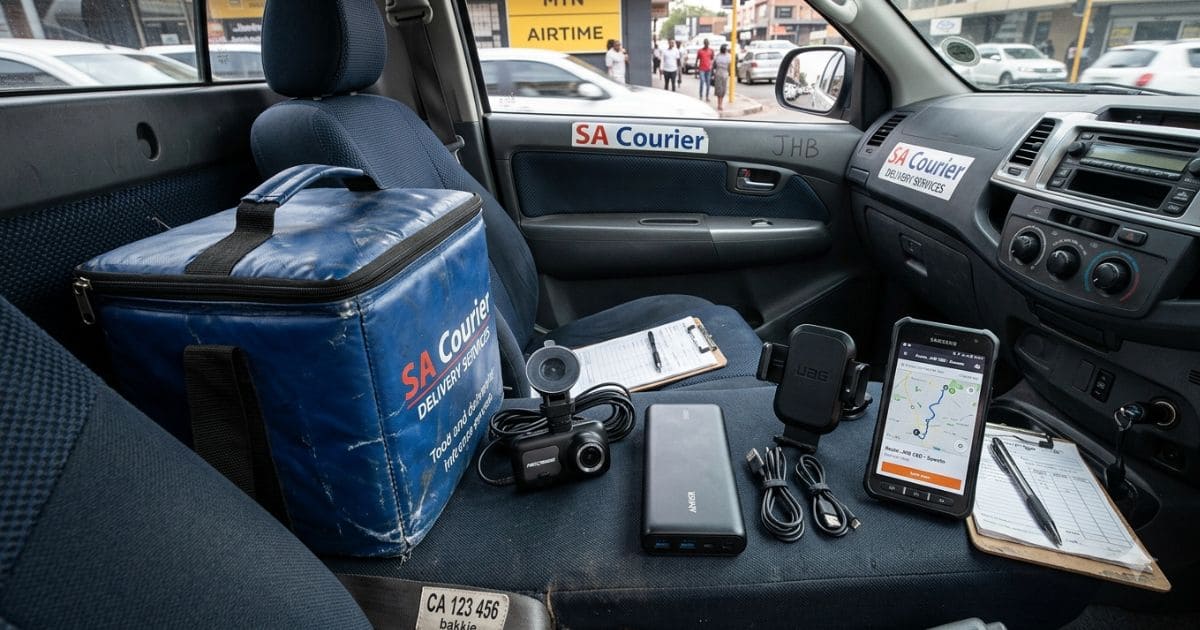
A courier driver starter pack is the basic equipment, apps and documents you need to start delivering. If you're just starting out, whether on a gig app or an owner-driver contract, the right kit makes the job easier and protects you when something goes wrong. Very little of it is legally required, but a few items are worth having from day one. This guide covers what's actually useful, roughly what it costs, and what you can safely skip.
Starter Pack at a Glance: What You Need and What It Costs
| Item | Typical Price | Priority | Who Needs It |
|---|---|---|---|
| Smartphone with mobile data | Varies by phone and data plan | Essential | All drivers |
| Navigation app (Google Maps or Waze) | Free | Essential | All drivers |
| Courier or delivery driver app | Provided by the courier or platform | Essential | All drivers |
| Phone mount | R100-R800 | Essential | All drivers |
| Power bank (10,000-20,000mAh) | R250-R500 | Recommended | All drivers |
| Dual-USB car charger | R100-R250 | Recommended | Cars and bakkies |
| Dashcam | R300-R7,000 | Recommended | Cars and bakkies, especially full-time drivers |
| High-endurance memory card (64GB) | R250-R800 | Recommended | Anyone with a dashcam |
| Insulated thermal bag | R300-R900 | Recommended | Food delivery |
| Tyre repair kit | R150-R300 | Recommended | Cars and bakkies |
| Basic first aid kit | R100-R250 | Recommended | All drivers |
| High-visibility vest | R80-R150 | Recommended | Night deliveries and riders |
| Cargo net | R150-R350 | Optional | Parcel drivers using a bakkie |
| Portable jump starter | R500-R1,200 | Optional | Cars and bakkies |
| Reflective warning triangle | R100-R200 | Legal requirement | Cars and bakkies (not motorcycles) |
| Protective helmet | About R1,200 retail (Uber Eats SA, December 2023) | Legal requirement | Motorcycle and scooter riders |
Last updated: 12 October 2026. Prices are general market estimates and vary by brand and retailer. The helmet figure comes from the Uber Eats South Africa helmet promotion of 5 December 2023, so compare current prices before buying.
The Kit Is the Cheap Part
A dashcam costs R300 to R7,000. The expensive mistakes are a bad contract, the wrong insurance and missed tax. If you're heading for an owner-driver contract, the Owner-Driver Guide covers all three.49-page PDF · Once-off R99 · Instant download
Why Equipment Matters
South African traffic is unpredictable, and accident liability disputes are common enough that many drivers consider a dashcam worthwhile insurance against a "he said, she said" argument after a collision. Beyond that, the core equipment list is mostly about keeping your phone charged and mounted so you don't miss orders, and, for food delivery, keeping meals at a temperature that doesn't tank your customer rating.
Dashcams: What to Know Before You Buy
Dashcam prices in South Africa span a wide range depending on resolution, night performance, and whether the camera records front-only or front-and-rear. Here's a rough guide to what different price bands typically get you:
| Tier | Typical Price | What You Get | Best For |
|---|---|---|---|
| Entry-level | R300-R1,000 | 1080p, basic day/night recording, single channel | Part-time gig-app drivers |
| Mid-range | R1,500-R3,500 | 1440p-2K, better night vision, front + optional rear | Regular gig-app or part-time owner drivers |
| Premium | R3,500-R7,000 | Dual-channel, parking mode, GPS logging, app connectivity | Full-time owner drivers on long daily routes |
What actually matters for South African conditions: heat tolerance (cameras left on a sunny dashboard need to handle high temperatures without failing), a secure mount that won't sag over time, and a high-endurance memory card designed for constant overwrite-and-record cycling. A standard SD card will typically fail within months under that workload. Expect to pay R250-R800 for a reliable 64GB high-endurance card.
Whether a dashcam is worth prioritising also depends on which path you've taken into courier work. Read our comparison of gig apps versus owner-driver contracts if you haven't decided yet, since full-time bakkie routes generally justify the extra spend more than occasional gig-app shifts do.
Navigation and Power
- Phone mount: a dashboard or vent mount from R100-R300 works for most cars; heavier-duty mounts with more adjustment run R400-R800
- Car charger: a dual-USB fast charger costs R100-R250
- Power bank: a 10,000-20,000mAh power bank costs R250-R500 and covers you during load-shedding or a long shift away from your car charger
Phone, Apps and Digital Skills: The Technology You Need
- Smartphone: a recent Android phone or iPhone that can run the delivery app and navigation at the same time and last a full shift on a charge. Check the minimum operating-system version on the driver app's store page, since apps can stop working on older phones.
- Mobile data: navigation, delivery apps and proof-of-delivery photos all use data, so a plan that won't run out mid-shift matters more than the price of the phone.
- Navigation app: Google Maps and Waze are both free. Google Maps also lets you download offline maps of your area, which helps where the signal is weak.
- Courier or delivery app: the company's driver app handles job offers, routes and proof of delivery. App-based owner-driver work, such as QikTruck or Skynet-linked loads through Droppa, works the same way, and our list of courier companies hiring owner drivers shows which ones use apps.
- Banking app: a bank account with a mobile banking app lets you check payments as they arrive and keep a record of income.
The digital skills that matter are practical ones: planning a route, taking a clear proof-of-delivery photo, answering customer messages quickly and keeping digital records of your income and expenses. If you're self-employed, those records are also what you'll need at tax time. Check the current rules on deductible expenses with SARS or a registered tax practitioner.
Food and Parcel Transport Gear
Options range from generic insulated bags (R300-R500) to platform-branded bags sold by delivery apps (R600-R900), which tend to be sturdier and signal to customers that you're a serious operator. If you're delivering parcels rather than food, a cargo net (R150-R350) to stop items sliding around in a bakkie is a cheap, practical addition.
Helmet and Gear for Scooter and Motorbike Riders
- Helmet: in December 2023, Uber Eats South Africa listed new open-face and full-face helmets at a retail price of R1,200 in a helmet promotion, which is a useful benchmark. Prices vary by brand, so compare before buying and choose a helmet that fits snugly rather than the cheapest option.
- High-visibility vest or jacket: a vest costs R80-R150 and makes you easier to see on night deliveries.
- Riding gloves and rain gear: these keep you riding safely and comfortably in wet or cold weather.
- Insulated bag: choose one with shoulder straps and reflective strips so it stays secure on the bike and you stay visible after dark. Prices follow the R300-R900 range above.
- Phone mount and power bank: use a mount that suits handlebars, and carry a power bank so a long shift doesn't end with a flat phone.
A warning triangle isn't required on a motorcycle, which is why it's missing from this list. If you're riding for Checkers instead of working on contract, see what the Checkers Sixty60 driver salary looks like in practice and how to apply as a Sixty60 driver.
Vehicle and Safety Essentials
- Tyre repair kit: R150-R300
- Reflective warning triangle: R100-R200 (compulsory in cars and bakkies, but not on motorcycles)
- Basic first aid kit: R100-R250
- High-visibility vest: R80-R150, useful for night deliveries or roadside stops
- Portable jump starter: R500-R1,200, optional but useful if you can't always wait for roadside assistance
Documentation Checklist
- Valid driver's licence
- Vehicle registration papers
- Comprehensive insurance certificate showing business-use or carriage-for-reward cover
- PrDP, only if your vehicle needs one. A goods vehicle with a gross vehicle mass over 3,500kg requires a PrDP, but most bakkies and panel vans fall below that. See the Western Cape Government's PrDP guide for the full list.
- Company ID card, if issued by the courier you work for
Store digital copies somewhere accessible even if your originals are lost or stolen. A phone photo backed up to cloud storage is enough. For a full breakdown of what's required to apply in the first place, see our guide on how to become a courier driver in South Africa.
Heading for an Owner-Driver Contract?
Paperwork is only the start. See which contract clauses cost drivers money and which 3 insurance policies you actually need, with all 13 courier companies covered.49-page PDF · Once-off R99 · Instant download
What to Buy First on a Tight Budget
Absolute minimum to start (under R500)
- Phone mount
- Dual-USB car charger
Add within your first month (R1,000-R1,500)
- Entry-level dashcam
- Power bank
- Thermal bag, if doing food delivery
Add once you're earning consistently (R1,500-R3,000)
- Upgrade to a mid-range or dual-channel dashcam
- Basic roadside safety kit
- High-endurance memory card
Riding a scooter or motorbike? Buy a helmet before anything else on this list. It's a legal requirement, so it comes before your first shift, not after your first paycheque.
Frequently Asked Questions About Courier Driver Equipment
A delivery driver needs a smartphone with mobile data, a navigation app, the courier's or platform's driver app, a phone mount and a way to keep the phone charged. A dashcam, power bank and, for food delivery, an insulated thermal bag are strongly recommended but optional. Cars and bakkies must carry a warning triangle, and anyone on a motorcycle or scooter must wear a protective helmet. See the at-a-glance table for typical prices.
For food delivery you need a smartphone with mobile data, the delivery app, a phone mount, a power bank and an insulated thermal bag, which costs roughly R300-R900. A dashcam is optional but useful. If you ride a scooter or motorbike you also need a protective helmet, which is a legal requirement.
Yes. Regulation 207 of the National Road Traffic Regulations requires every person riding a motorcycle, including a scooter, to wear a protective helmet that is designed for motorcycle use, fits properly and has its chin strap fastened. Buy a helmet that fits snugly rather than the cheapest option, because it is the one piece of kit that protects you directly in a crash.
A courier needs a smartphone, mobile data and a power bank as the core devices, with a dashcam as an optional extra. The key applications are a navigation app such as Google Maps or Waze, the courier's driver app and a mobile banking app. The digital skills are route planning, taking clear proof-of-delivery photos, handling customer messages quickly and keeping digital records of income and expenses.
You need a recent Android phone or iPhone that can run the delivery app and a navigation app at the same time and last a full shift on a charge. Check the minimum operating-system version on the driver app's store page before you apply, because apps can stop working on older phones. Pair the phone with a secure mount and a power bank.
It's not required by gig apps, but it's worth having. Food delivery drivers make many short trips a day in unpredictable traffic, and a dashcam gives you evidence if there's a dispute over an accident or a customer complaint.
As a self-employed contractor, business-related equipment can generally be claimed as a deduction under South African income tax rules, but the exact treatment depends on your circumstances. Keep every receipt and confirm your specific deductions with a registered tax practitioner or SARS.
You can start with a basic phone mount and a car charger, both under R500 combined. A dashcam and thermal bag can wait until your first month's earnings come in, though many drivers prefer to have at least a basic dashcam from day one.
A decent dashcam typically lasts 2-4 years with normal use. Thermal bags wear out faster, usually needing replacement every 6-12 months for hygiene reasons. Phone mounts and power banks generally last 1-3 years.
Gradually is fine and often smarter. Start with a phone mount and charger, add a dashcam once you can afford one, then a thermal bag if you're doing food delivery. There's no need to buy everything before your first shift.
Some insurers offer small discounts or faster claims processing for dashcam footage, but this varies by provider and isn't guaranteed. It's worth asking your insurer directly whether they recognise dashcam evidence and whether it affects your premium.
Remove your dashcam, phone mount and thermal bag whenever you leave the vehicle unattended, even briefly. Most smash-and-grabs target visible valuables, so keeping the interior clear of loose gadgets is your best low-cost protection.
It's possible but not ideal, since you need your phone free for navigation and accepting delivery orders. Phones also tend to overheat when used for continuous recording in South African summer heat, which can shorten their lifespan.
Food that arrives at the right temperature tends to get better ratings than food that's gone cold or soggy in transit, which can indirectly support better tips over time. A properly insulated bag costs R300-R900 and is one of the more worthwhile purchases for food delivery work.
A single-channel (front-facing) dashcam covers the most common accident scenario and suits part-time gig-app drivers. A dual-channel model, which also records the rear, is worth the extra cost for full-time owner drivers covering long daily routes.
A high-endurance microSD card is built to handle the constant overwrite-and-record cycle of a dashcam, unlike a standard card, which can fail within months under that load. Expect to pay R250-R800 for a reliable 64GB high-endurance card.
General retailers like Takealot and Makro stock most of this equipment, and price-comparison sites like PriceCheck let you compare models and prices across sellers before buying.
Ready to Earn From Your Kit?
11 chapters on vehicle requirements, contracts, insurance, pricing your work, SARS provisional tax and your first 90 days. Everything a kit list can't tell you, with the worked numbers behind it.49-page PDF · Once-off R99 · Instant download
Want to see who's hiring first? Check which courier companies are recruiting owner drivers right now.
Related Reading
- Courier companies looking for owner drivers in South Africa
- Courier driver jobs in South Africa: own car or bakkie
- How to become a courier driver in South Africa
- DSV driver vacancies guide
- Delivery driver salary comparison
- Checkers Sixty60 driver salary: what you'll really earn
- How to become a Checkers Sixty60 driver
NCR/NCA notice: Internet Business SA is not a registered credit provider. This content is general information, not financial, legal or tax advice, and does not constitute a National Credit Act (NCA) disclosure.
Disclaimer: Internet Business SA is not affiliated with any specific dashcam, GPS tracking or equipment brand mentioned or implied on this page. Prices are general market estimates at the time of writing and can change. References to road traffic rules are a plain-language summary, so check the current regulations or your licensing authority before relying on them. Always compare current prices before buying, and confirm tax-deduction treatment with a registered tax practitioner.